

 ECP/ECES and ECP/AAU Programs
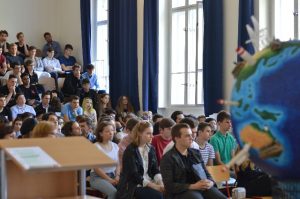
This is a partnership with the East and Central European Studies (ECES) study abroad programme of the Philosophical Faculty of Charles University and with the Anglo-American University (AAU) in Prague. ECES, a semester program for American and Erasmus students, offers classes in the Humanities: Art History, Gender Studies, Sociology, Psychology, Literature, History, Economics, Politics. AAU offers undergraduate and graduate programs in International Relations, Business Administration, Humanities, Journalism and Media, Visual Arts, Political Science, Law.
These partnerships constitute a unique opportunity for Year 4 and Upper school students to attend lectures and to get a taste of university life. It also helps them in their choice of IB options and of university. The process is simple: students look at the syllabi of the different courses, choose one or two specific classes they would like to attend and ECP organises their visit. ECP students are authorised two absences per term to attend lectures but are welcome to attend more outside of their class time.
 Subject-Specific Lectures
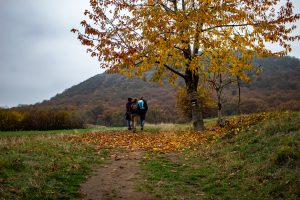
Individual departments organise lectures on particular themes within their subject, attended either by whole year groups or by students with a specific interest in the topic. Through the initiative of ECP’s academic departments, the school has welcomed specialists from a range of academic fields, including history, economics and science. In recent years, speakers have included:
English Language & Literature
- Kathryn Evans, Ross Welford, and Rob Bradley (British authors) — Literature, creative writing, and poetry
- Seth Burkett, Mary/Mara Menzies, and Karl Nova (British literary authors & artists) — Creative writing, poetry, and storytelling
- Dr. Hana Ulmanová (Literary translator & academic) — Literary translation and academic analysis
- Jenny Valentine (British author) and Ash Dickinson (British performance poet) — Literature and creative writing
- Lucy Strange (Gothic fiction author) and Taylor Jenkins Reid (Bestselling novelist) — Gothic literature and novel writing
- Andrew Pratt (British crime writer) — Crime fiction and the publishing industry
- James Stafford (Writer & journalist) — Sports writing and journalistic prose
Czech Language & Literature
- Jan Novák (Czech author and biographer) — Czech literature and biography
- Igor Malijevský (Poet, photographer, and physicist) — Creative writing and modern poetry
- Daniela Šafránková and Martin Vopěnka (Czech authors) — Literature and creative writing techniques
- Slam Poets (From Czech Slam Poets) — Performance poetry and improvisation
Humanities
- Barbora Grečnerová (Representative, Václav Havel Library) — Modern history and political essays
- Prof. Markéta Křížová (Historian, Charles University) — World history and colonialism
- Čeněk Růžička (President, Committee for the Redress of the Romani Holocaust) — Romani history, Romani Holocaust, and historical memory
- Mgr. Yasir Abu Gosh (Social Anthropologist, Charles University) — Romani history, roots, and cultural identity
- Sieglinde Vendolsky (Survivor of post-WWII expulsion) — Modern European history and Czech-German relations
- Trevor Sage (Volunteer Stolpersteine cleaner) — Modern history, Holocaust remembrance, and community action
- Dr. William Eddleston (History Professor, Anglo-American University & Charles University) — 20th-century history and Nazi racism
- Jitka Režná-Fajtlová (Daughter of WWII RAF pilot František Fajtl) — WWII history and post-war political persecution
- Lady Milena Grenfell-Baines, MBE (Winton train rescue survivor) — Modern history and refugee migration
- Tomáš Sousedík (Son of inventor & anti-Nazi resistance hero Josef Sousedík) — Czech resistance history and engineering history
- Jan Bubeník (Velvet Revolution student activist & former politician) — Modern Czech history and civic activism
- Angelina Aow (International Educator & School Consultant) — Civics, multiculturalism, diversity, inclusion, and anti-racism
- Štefan Balog (University student & Romea activist) — Civics, discrimination, and educational policy
- Dr. Gerhardt Bubník (First Czechoslovak at Harvard Law School) — Law, ethics, and civic responsibility
- Fr. Patrik Banga (Journalist/author), Filip Boháč (Dominican prior), and Jan Urban (Dissident/educator) — Civics, ethics, and human rights
- Monika Domincová (Local activist) — Civics and regional environmental policy
- Viktor Kundrák (Director of Human Rights Dept, Czech Govt Office), Michal Zapletal (Futurist), Michal Miko (RomanoNet founder), and Chloe Laycock (ECP intern) — Civics, human rights, and minority rights
- Lucie Zachariášová (Attorney, Jsme Fér initiative) — Law, human rights, and advocacy
- Jan Barta (ECP Alumnus) and Mikuláš Minář (Co-founder, Milion chvilek pro demokracii) — Politics, civics, and modern democracy
- Tomáš Pospíšil (ECP Alumnus & diplomat) — International relations and diplomacy
- Alexandr Vondra (MEP), Roman Joch (Občanský institut), PhDr. Michal Smetana (Charles Univ), and Jakub Andrle (People in Need) — International relations, global politics, and security studies
- Eva Horelová (European Commission Representation in CR) — Global politics and international diplomacy
- Pavla Gomba (UNICEF CR), Sylva Horáková (Doctors Without Borders), and Matt Field (British Ambassador to CR) — Diplomacy, global politics, and humanitarian relief
- Lucie Samcová – Hall Allen (EEAS Protocol Chief / former EU Ambassador) — International diplomacy and public career paths
- Jiří Rusnok (Governor of the Czech National Bank) — Macroeconomics and monetary policy
- Tomáš Sedláček (Macroeconomist) — Economics, philosophy, and history of economic thought
- Prof. Aleš Stuchlík, DSc. (Physiologist, Czech Academy of Sciences) — Cognitive psychology and neuroscience
- Dr. Ingmar Gorman, Anna Hejlová, Charlie Dang, and Dr. Eva Nouzová (Psychologists & ECP alumni) — Applied psychology and clinical research
- Tom Damms and Petra Damms (Founders, Dignity Restoring Hope) — Sociology, migration, and humanitarian integration
- Rabbi David Maxa (Ec Chajim Progressive Jewish Community) — Religious studies and sociology
- Petra Černá (Head of Counseling, Cesta domů hospice) — Sociology, health studies, and palliative care
- Albert Sekava and Magdalena Sadílková (Medici na ulici) — Sociology, social work, and medical ethics
- Prof. Julie Mildorfová Leventon (Czech Academy of Sciences) — Geography, political ecology, and environmental policy
- Jan Hvízdal (Arctic guide & photographer) — Geography, climatology, and polar research
Science
- RNDr. Kristýna Falátková, Ph.D. (Czech Academy of Sciences) — Environmental science, hydrology, and soil ecology
- Dr. Jane Goodall (Primatologist & conservationist) — Biology, environmental studies, and ecology
- Barbara Jagadics, Tom Zahrádka, and Antonín Muller (Eco-design professionals) — Environmental systems, eco-design, and green engineering
- Doc. Petr Hadrava (Astrophysicist, Czech Academy of Sciences) — Astrophysics and astronomy
- Dr. Petr Brož (Institute of Geophysics, Czech Academy of Sciences) — Geophysics, planetary science, and space exploration
- RNDr. Štěpán Rak (Paleontologist & curator) — Earth science, geology, and paleontology
- MUDr. Martin Jan Stránský (Neurologist & Yale professor) — Human physiology, neuroscience, and digital wellbeing
The Arts & Media
- Štěpánka Jislová (Comic illustrator) — Visual arts, graphic novel illustration, and visual narrative
- Nika Kupyrova (ECP Alumna & visual artist) — IB Visual Arts and fine art practice
- Sonia Leong (Manga illustrator) — Visual arts and manga illustration
- Kateřina Klementová (Ministry of Culture), Alexandra Karpuchina (Gallerist), Jan Látal (Film director), and Petr Hloušek (Scenographer) — Visual arts, film, scenography, and cultural curation
- Kristián Mensa (Kriss) (Actor, dancer, illustrator) — Performing arts, movement, and expressive dance
- Dr. Barbara Day (Theatre expert & ECP Board Member) — Drama, performance, and Czech theatre history
- Michal Müller (Zither musician) — Music performance, ethnomusicology, and folklore
- Patricie Fuxová (Lead singer of Vesna / ECP Alumna) — Music, song arrangement, and live performance
- Marc Cram (Improv actor) — Drama and improvisational comedy
- Rob Cameron (BBC correspondent) — Media studies, broadcast journalism, and radio production
- Ian Willoughby (Radio Prague International) — Media studies and broadcast radio journalism
- Adéla Mazánková (Editor-in-Chief, Cosmopolitan CR) — Media studies and print publication
- Martin Ehl (Foreign News Editor, Hospodářské noviny) — Journalism and foreign news editing
- Martina Kotrbová (Editor-in-Chief, Byt a zahrada) — Media studies and print history
- Giles Whittell (Times correspondent), Eva Dvořáková (PR Director), and Teddy Keefe (Video game industry expert) — Media careers, PR, writing, and digital narrative media
- Honza Vedral (Music journalist & Editor-in-Chief, Headliner) — Journalism and biographical writing
 Subject-Specific Trips
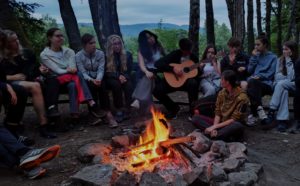
The English College is an academic school and therefore effective teaching and learning is our priority. Teaching does not take place only in the classroom, but also elsewhere. Almost all Faculties organise educational trips in Prague – as part of Prague Programme – and also around the Czech Republic. This gives students an exceptional opportunity to connect what they have learnt in school with real life situations.
Czech
Every year, the Czech Faculty takes students on a literature trip, such as the Mácha or Karel Čapek Trip. Students visit the places connected with the author’s life, read texts written by or about the author; they read their correspondence, but above all, they discuss their unique life stories and the impact of their literary work. Discussions that take place in a beautiful natural setting have a very special flavour and make these trips unforgettable both for students and their teachers.
English
Whilst opportunities for English language and literature trips in Prague are limited, we take Year 1 students to the Old Town to research and produce brochures and guides for tourists. In October, students from Years 3-5 are invited to travel to the UK to attend the Cheltenham Literature Festival. Cheltenham celebrates the written and spoken word, presenting the best new voices in fiction and poetry alongside literary greats and high-profile speakers. It is a fabulous trip which gives students the opportunity to experience the regency spa town of Cheltenham as well as meeting some of the greatest contemporary thinkers and writers.
Arts
Various trips and excursions are organised by the Arts Faculty, under the Prague Programme. The faculty makes excellent use of the cultural institutions available in the Czech Republic and further afield. Trips in the Visual Arts have previously included Dresden, Vienna, Venice, Rome, Amsterdam and Paris – allowing students to enrich their cultural appreciation and expand their visual understanding by viewing both traditional and contemporary art forms.
Modern Languages
Studying foreign languages would not be effective without exploring cultures and countries, where the languages being studied are spoken. Young people naturally love meeting their peers despite the language barriers, which is a good basis for an exchange programme.
- For many years we have been organising a French Exchange and we have established a strong relationship with the Lycée Notre Dame de Rezé in Nantes. We have also in the past few years established exchanges with Instituto Velázquez in Seville, Spain and St. Raphael Gymnasium in Heidelberg, Germany. Every year our students spend a week with the Spanish/French/German families and at a different time in the year their students come to Prague and enjoy the hospitality of our ECP families. During the visits, the host school prepares a diverse cultural programme for the students, through which they explore the local region and enhance the intensity of their cultural visit.
Humanities
The Humanities Faculty organises a number of trips each year. These are mostly day trips to local places of interest, such as the annual visit to the Škoda factory, which is run by the Geography Department or our History students’ walking tour of renaissance sites in Prague city centre.
Science
As an integral aspect of both the IB and Pre-IB courses, students monitor, analyse and evaluate conditions in several local ecosystems. They investigate how changing abiotic factors affect the abundance and diversity of local flora and fauna. This helps the development of their knowledge and understanding of human effects on ecosystems and inculcates a wider appreciation of both the fragility and resilience of natural systems.
 The Prague Programme
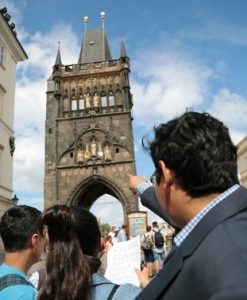
Prague is not only a beautiful city, which is now visited by thousands of tourists, it is also a city where you can see and feel not only the history of the Czech Republic, but also of Europe. King Charles IV made Prague the centre of Europe, founded a university here and built what was then a modern town.
To artists, Prague is a place of many galleries and amazing art collections of every period. It is a place that can serve as a textbook of architecture. Prague’s museums house collections from every area of knowledge. Its public and botanical gardens are workplaces for academics as well as places for recreation. In other words, Prague offers endless possibilities for exploring and learning.
This is why we established the Prague Programme.
By the end of their studies at ECP, our students, therefore, know Prague much better and also know a lot about Prague – which, as students of the English College in Prague, they should!
 The Lecture and Talk Programme
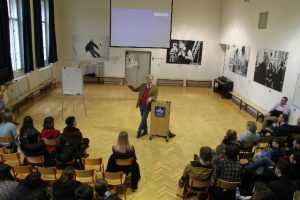
It is very important for young people to meet, at the right time, someone who can inspire them in their lives and be a role model. In order to enable our students to meet a range of interesting people, we organise a Lecture and Talk Programme, which has become an important tradition at the ECP.
Over the years. we have invited into school many specialists in their field – to talk about their professions, projects or just to share their life stories with the students. We are proud that in recent years, former students who have fascinating careers have been amongst the speakers.
There are usually four guest speakers annually and lectures are often connected with the Theme of the Year. Each lecture is followed by a discussion and although the programme is primarily designed for students in Years 4 and 5, students from other years are also welcome to attend if they are interested in the topic. The lectures are also a good opportunity for TOK-style discussions. Students and their tutors discuss the topic before each lecture and then follow it up again after the lecture has taken place.
See the overview of the Lectures and Talk Programme.
 Academic Cooperation
Academic Cooperation
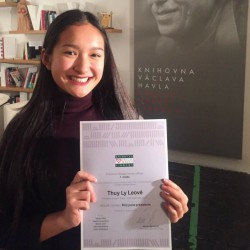
ECP aims to extend students’ experience beyond the classroom, including within academic subjects. Therefore, we are actively seeking to establish partnerships with academic institutions where students can gain new insights. For instance, several students recently took part in the Czech Academy of Sciences internship program, while others benefit from the fact that ECP is a Faculty School of Charles University. Prague University of Economics and Business (VSE) lecturers have visited the ECP to present university lectures centred around mathematical themes, giving our students an insight into how their academic knowledge can be applied to complex scenarios, and ECP students have attended lectures and workshops at the at the Czech Technical University Department of Mathematics as part of our work experience programme.